
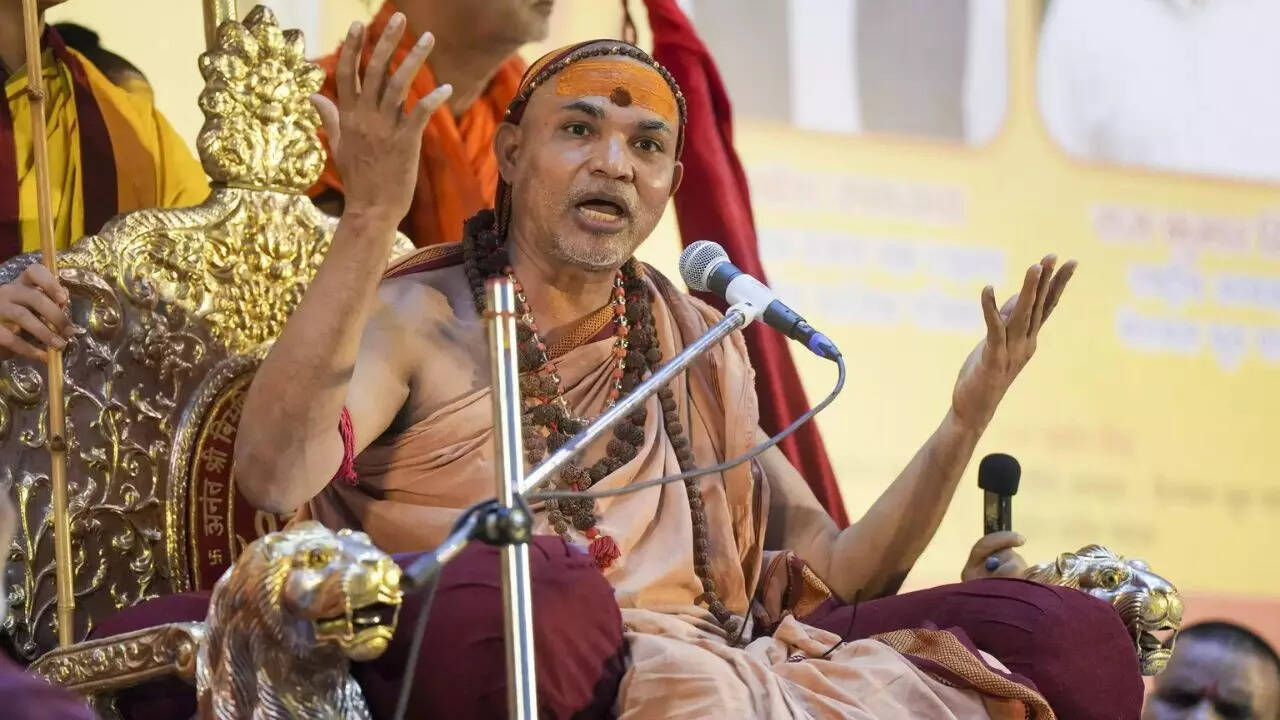
Swami Avimukteshwaranand Saraswati faces sexual exploitation charges under the Protection of Children from Sexual Offences Act after a special court in Prayagraj ordered police to register a case against him and his disciple. The complaint alleges two minor boys were sexually exploited at the seer's camp during the 2025 Magh Mela and Maha Kumbh. Avimukteshwaranand categorically denies the accusations, calling them fabricated and claiming the alleged victims were never at his gurukul but were students at a school in Hardoi.
The charges arrive at a moment when Avimukteshwaranand's spiritual authority itself remains legally contested. He declared himself Shankaracharya of Jyotirmath in 2022 after his guru's death, but the Supreme Court stayed his formal coronation ceremony while a succession dispute remains pending. This creates the peculiar situation of a religious leader using a title that courts have effectively frozen, yet continuing to draw millions of followers who recognize his spiritual authority regardless of legal technicalities.
The complainant, Ashutosh Brahmachari Maharaj, also involved in the Krishna Janmabhoomi-Shahi Eidgah dispute, claims he was attacked on a train while traveling to submit evidence. He alleges an unidentified man tried to assault him with a sharp object, supposedly for a reward announced by one of the seer's followers. Avimukteshwaranand dismisses this as suspicious, questioning how such an attack could occur in a train compartment without witnesses.
The controversy reveals the inherent tension between ancient religious institutions and modern legal frameworks. The four traditional Shankaracharya seats established by eighth-century philosopher Adi Shankaracharya have no single central authority governing succession. Unlike many religious positions, the title is traditionally decided within monastic orders based on scholarship and acceptance among senior monks, not state recognition. When disagreements arise, as they have at Jyotirmath, the courts become arbiters of spiritual legitimacy—a role they are structurally ill-equipped to perform.
Uttar Pradesh Chief Minister Yogi Adityanath has stated that no individual is above the law and constitutional propriety must be respected, appearing to question the legitimacy of anyone claiming the Shankaracharya title without proper recognition. This positions the ruling establishment awkwardly between respecting Hindu religious autonomy and enforcing legal compliance, while opposition parties frame the dispute as an attack on a Hindu religious figure.
The case illuminates how accusations of sexual abuse within religious institutions become entangled with questions of spiritual succession, political positioning, and legal authority. Whether the charges prove substantive or fabricated, the controversy exposes the vulnerability of religious leaders who operate in the space between divine authority and earthly accountability. The outcome will set precedent for how India's courts handle the intersection of ancient spiritual traditions and contemporary legal standards.