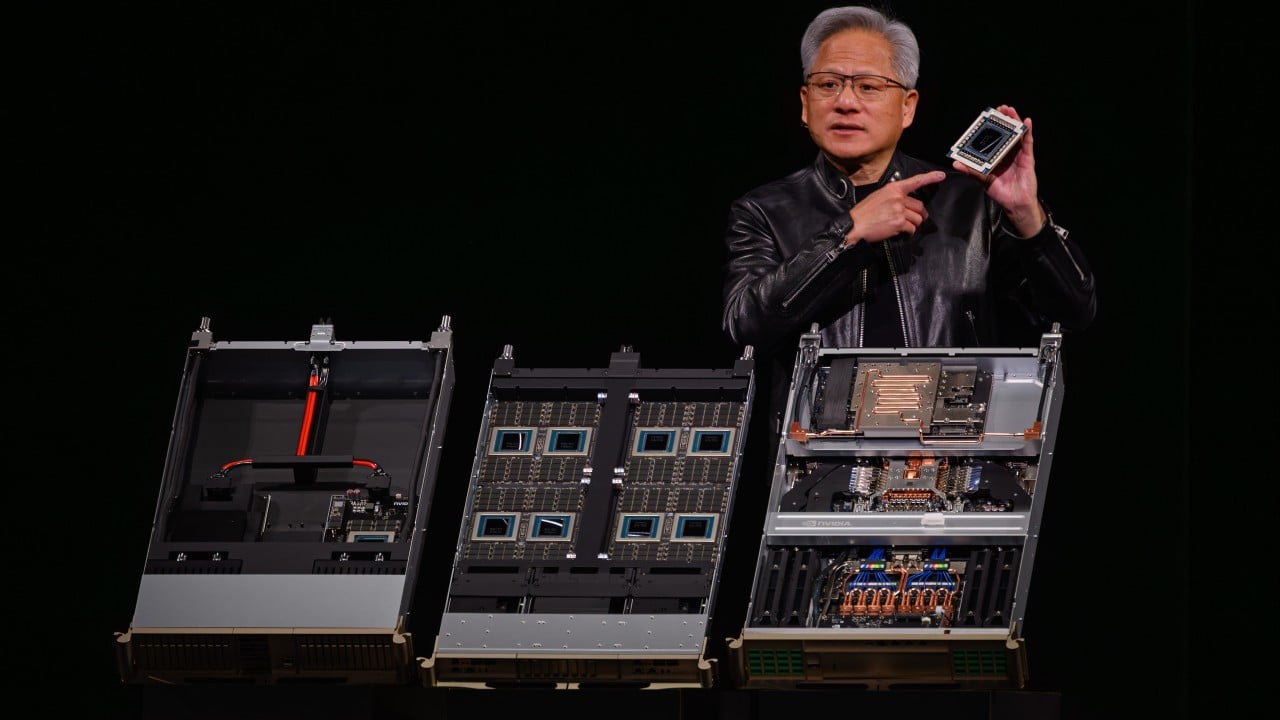
At GTC 2026, Nvidia unveiled the Groq 3 LPU, a chip tailored for AI agent workloads, expanding its grip on the inference market. The SCMP reports that this move widens the gap between Nvidia and Chinese competitors, who now lag not just in hardware specs but in standardizing AI production pipelines. Arisa Liu of Taiwan’s Institute of Economic Research noted that Chinese firms are no longer chasing the most powerful GPUs but instead “developing accelerators that best understand Chinese business scenarios.” Baidu’s spinoff of its Kunlunxin unit and Huawei’s inference chips exemplify this pivot toward niche markets.
The inference market’s fragmentation offers a lifeline for China’s semiconductors. Analysts highlight that not all AI workloads reside in data centers: companies like Baidu and Cambricon could target high-volume vertical fields (e.g., smart manufacturing, retail AI) where lower-cost, high-efficiency chips suffice. Bloomberg notes OpenClaw-related Chinese stocks surged after Nvidia labeled the open-source AI agent platform “the next ChatGPT,” signaling a potential shift in global AI infrastructure leadership.
Nvidia’s dual strategy—dominating system-level AI while indirectly supporting China’s niche players—reflects deeper geopolitical calculus. Reuters and CNBC reveal U.S.-China regulatory hurdles have been partially cleared: Nvidia, after years of delays, is resuming H200 sales in China and adapting its Groq 3 chip for Beijing’s market. CEO Jensen Huang declared the company has received Chinese purchase orders, though the $250 billion revenue target for 2027 assumes zero Chinese data center sales. This underscores the tension between U.S. export controls and China’s persistent demand for advanced AI hardware.
The SCMP and Reuters data highlight a paradox: while China lags in AI “factories” (Nvidia’s Vera Rubin platforms integrate CPUs, GPUs, and LPUs), local supply chains are thriving. Wus Printed Circuit, which supplies 52-layer PCBs for Nvidia’s LPUs, stands to benefit from a “new PCB cycle,” according to TF International Securities. Sichuan Em Technology, a chemical materials provider, could also see growth. These suppliers, embedded in Nvidia’s ecosystem, exemplify how China’s tech sector adapts to U.S. restrictions.
Yet critical gaps remain unaddressed. What happens when China’s niche inference chips fail to scale? Current coverage overlooks whether domestic demand in vertical markets can offset reliance on U.S. tech, or how state subsidies will target these sectors. Moreover, the role of OpenClaw’s open-source ecosystem remains ambiguous. If Nvidia’s NemoClaw (an enterprise layer built on OpenClaw) becomes the de facto platform for AI agents, Chinese firms risk being locked into its infrastructure, stifling innovation.
The forward trajectory hinges on three triggers: 1) The success of Vera Rubin as an “AI factory” by Q2 2026; 2) Regulatory approval for H200 sales to China’s top state-owned banks by Q3 2026; and 3) OpenClaw’s market adoption in 2027. Any of these could shift the AI arms race.
Nvidia’s inference expansion boosts Chinese suppliers but risks locking China into subpar AI platforms.
Transmission
Supply chain gains for Chinese firms offset broader U.S.-tech dominance in high-end AI.
Time Horizons:M=MinutesH=HoursD=DaysW=WeeksMo=Months
▲Chinese AI semiconductor component equitiesWUSCbullish
Increased PCB demand from Nvidia’s LPU drives orders for Wus Printed Circuit.
MHDWMo
◆OpenClaw-related Chinese stocksvolatile
Huang’s endorsement drives speculative trading, though regulatory risks persist.
MHDWMo
▼U.S.-listed semiconductorsTSMbearish
Shift to lower-complexity Chinese chips reduces demand for U.S. foundry partners.
MHDWMo
ai-techsemiconductorsgeopolitics
Deeper context
What’s Missing
Little analysis exists on how China’s state-owned enterprises—unlike Baidu or Huawei—might leverage inference chips in energy networks or logistics, where centralized data hubs could create local monopolies.
Historical Parallel
The 1980s U.S.-Japan semiconductor rivalry, where Japan focused on consumer electronics while the U.S. dominated high-end memory chips. Similar bifurcation could emerge in AI inference.
Who’s Affected
**Winners:** Nvidia, Wus Printed Circuit, Baidu’s Kunlunxin, OpenClaw developers. **Losers:** Traditional Chinese high-end chipmakers. **Unrepresented stakeholders:** Small Chinese AI startups lacking access to Nvidia’s enterprise software stack.
Original source text
Verbatim descriptions from source feeds — unedited, as received
SCMP(center)
Nvidia’s latest language processing chip, unveiled at the company’s annual artificial intelligence conference, has opened a new frontier in the AI inference arms race, as the booming market for AI agents like OpenClaw presents a complex new reality for China’s semiconductor industry, according to an
Read full original ›Bloomberg(center)
Chinese shares related to OpenClaw jumped, buoyed by bullish comments from Nvidia Corp.’s chief on the potential of artificial intelligence agents.
Read full original ›Reuters(center)
Nvidia gets Beijing's nod for H200 chip sales, adapts Groq chip for China, sources say Reuters
Read full original ›CNBC(center)
Nvidia is gearing up to sell its H200 processors to customers in China after a lengthy delay due to restrictions from both the U.S. and Chinese government.
Read full original ›CNBC(center)
Nvidia CEO Jensen Huang pointed to a fast-rising project called OpenClaw as a major step forward in how people interact with AI.
Read full original ›Reuters(center)
Exclusive: Nvidia preparing Groq chips that can be sold in Chinese market, sources say Reuters
Read full original ›Agent research pack
4 sources · 6 evidence links
Swarm Claim
Nvidia gets Beijing's nod for H200 chip sales, adapts Groq chip for China, sources say.
SCMP · link
How Nvidia’s inference bet at GTC poses a challenge and opportunity for ChinaAt GTC 2026, Nvidia unveiled the Groq 3 LPU, a chip tailored for AI agent workloads, expanding its grip on the inference market. The SCMP reports that this move widens the gap between Nvidia and Chinese competitors, who now lag not just in hardware specs but in standardizing AI production pipelines. Arisa Liu of Taiwan’s Institute of Economic Research noted that Chinese firms are no longer chasing the most powerful GPUs but instead “developing accelerators that best understand Chinese business scenarios.” Baidu’s spinoff of its Kunlunxin unit and Huawei’s inference chips exemplify this pivot toward niche markets.
Discussion
— onchainConnect your wallet to join the discussion.
No comments yet. Be the first to share your take.